
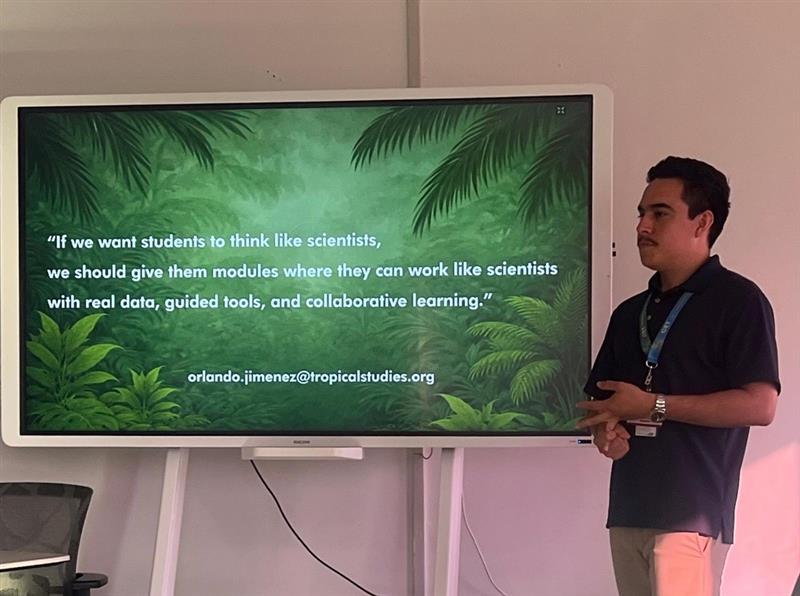
From January 6–9, 2026, the Conference of Latin American Geography (CLAG 2026) took place in Puerto Vallarta, Mexico, bringing together 150+ presentations exploring the role of geography in fields such as conservation, education, communities, and development. Beyond the sessions and poster discussions, CLAG felt like a space where communication quickly turns into action—where conversations and shared interests become collaborations, and where networking materializes into concrete opportunities across institutions and borders.
 This year’s participation highlighted a growing connection between OTS, OCELOTS, and Gala—a partnership that is helping bring OTS science and field-based learning to wider audiences through modern, interactive educational formats. OCELOTS (Online Content for Experiential Learning of Tropical Systems) is an international network of educators, tropical ecologists, instructional designers, and data specialists who develop research-based teaching modules that make tropical biology and conservation more experiential and data-driven. Gala is the open platform where these modules are created, refined collaboratively, and shared openly—making it easier for learners to engage with real projects through multimedia, interactive tools, and guided data exploration. Through this alliance, research connected to OTS field stations can become more visible, more accessible, and easier to engage with—without losing the scientific rigor that makes these projects valuable.
The conference presentation, “Interactive features and data learning in OCELOTS Modules,” focused on how interactive tools within OCELOTS modules help learners move beyond passive reading and into scientific practice. By engaging with real-world research projects—many rooted in tropical contexts like those supported by OTS—students can explore evidence, test ideas, and build technical confidence. These interactive experiences create a bridge between the data-rich nature of modern science and the curiosity that draws people to tropical ecology in the first place, translating research into learning pathways that are dynamic, intuitive, and easy to digest.
For OTS, this presence at CLAG matters because it strengthens the organization’s role not only as a hub for tropical research, but also as a connector for international collaboration and science communication. CLAG opened doors to new conversations—particularly with potential partners in Mexico and beyond—about future cooperation, academic engagement, and ways to keep expanding the reach of OTS research through the shared OTS–OCELOTS–Gala pathway. The growing relationship among these communities reflects a broader goal: helping tropical science travel further, reach more people, and inspire new work—inside and outside the classroom.
Sincere thanks are due to Ann Russell (Iowa State University) and Rebecca Hardin (University of Michigan) for their support and mentorship connected to this experience. Their guidance—and their long-term commitment to building community around collaborative, research-based learning—helped make this participation possible and meaningful.
To learn more, visit OCELOTS (https://ocelots.nrem.iastate.edu/) and Gala (https://about.learngala.com/).